Most bad chef hires are not bad people. They are good cooks placed in the wrong kitchen — a banqueting chef dropped into à la carte service, or a section chef promoted to run a pass they have never run. The fix is almost always in the process, not the candidate pool.
This is the process, start to finish.
First, be honest about which role you are filling
"Chef" is four or five different jobs. Before you write an advert or open a candidate profile, decide which rung you are hiring for, because it changes the salary, the search and the interview entirely.
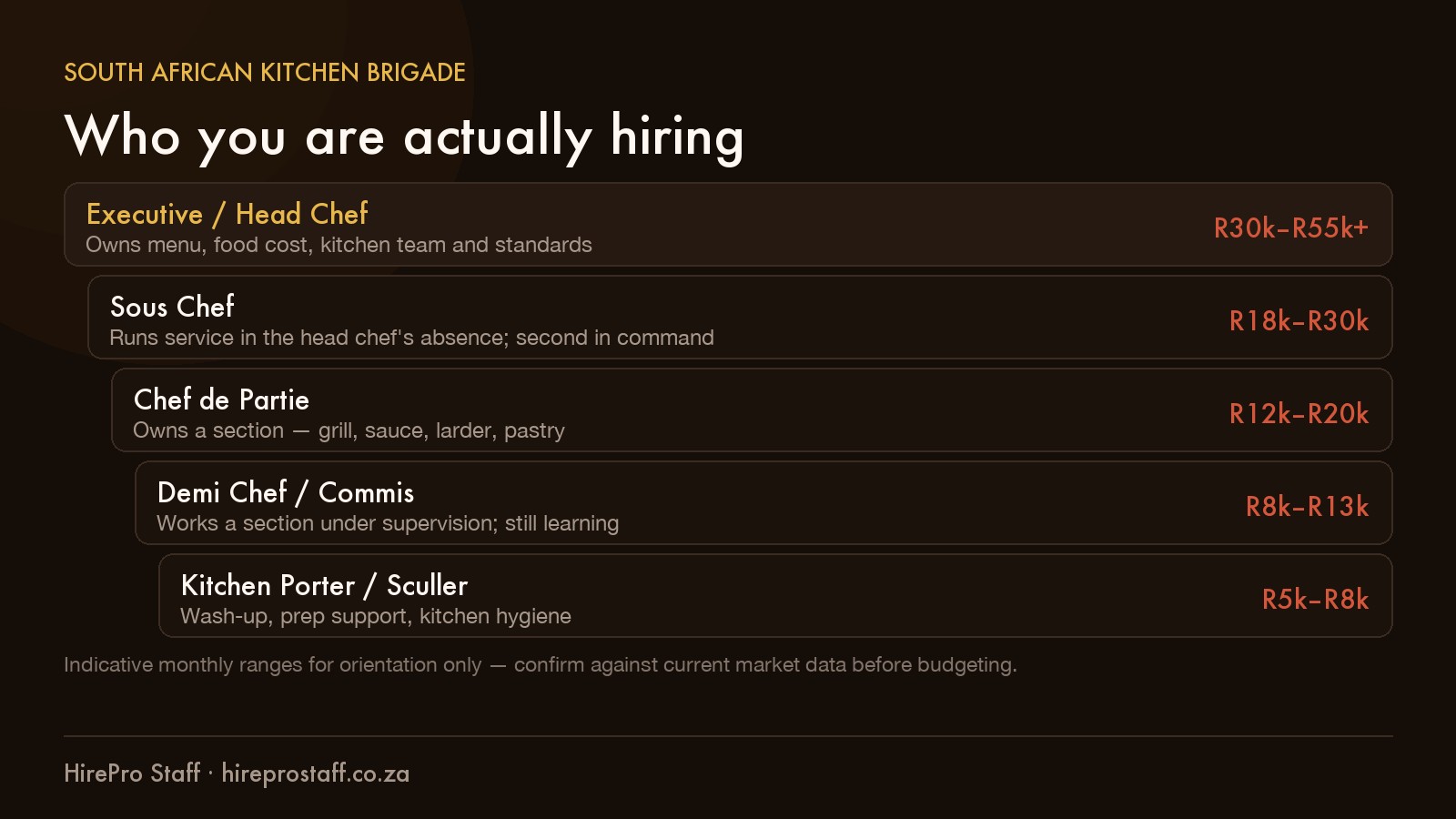
A common and expensive mistake is advertising for a head chef at sous chef money. You will get applications, but they will be from sous chefs who want the title, and you will be hiring someone into a job they have not done before while paying them as though they have.
Write a brief that describes the kitchen, not the job title
A chef reading your advert wants to know what their week will actually look like. The listings that attract strong candidates state:
- Covers per service and the split between à la carte, functions and banqueting
- Cuisine and menu size — a 14-item bistro menu is a different job to a 40-item hotel menu
- Brigade size and who reports to whom
- Hours and the shift pattern — straight shifts or splits, weekends, public holidays
- The realistic package, including live-in, transport or meal allowances if they exist
If you are not willing to put the shift pattern in the advert, expect to lose the candidate at offer stage when they find out.
Read the CV for evidence, not adjectives
Ignore "passionate" and "hardworking". Look for:
- Venue types, not just employer names. Five years at a chain restaurant is not five years of fine dining.
- Section ownership. Which station did they run, and for how many covers?
- Tenure pattern. Short stints are common in hospitality and are not automatically a red flag — but three roles in eighteen months deserves a direct question.
- Verifiable dates and named referees. A CV that has been reformatted by an agency is not the same as a CV that has been checked.
Ask about the gaps. Ask what happened. In this industry, closures, seasonal contracts and relocations are ordinary, and a straight answer tells you more than an unblemished timeline.
Run the process in the same order, every time
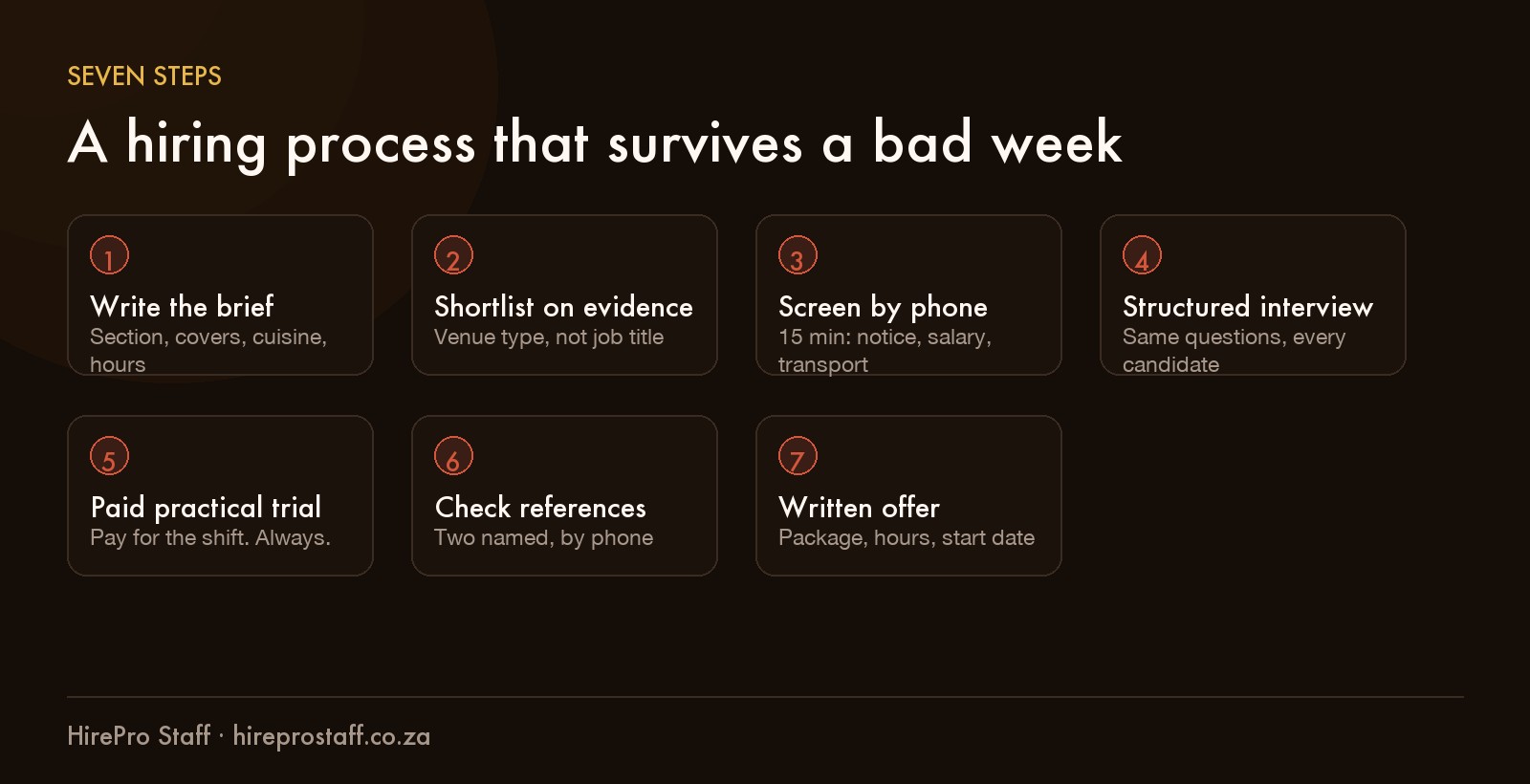
The phone screen is the highest-value fifteen minutes in the whole process. Cover four things and you will eliminate most mismatches before anyone travels anywhere:
- 1Notice period — when could they realistically start?
- 2Salary expectation — ask early, ask directly, and say your range.
- 3Transport — how will they get to a 06:00 prep start or leave after a 23:00 close?
- 4Why they are leaving — listen for what they are moving *towards*.
The trial shift: pay for it, and structure it
A practical trial is the single most predictive step in hiring a chef. Two rules make it useful and lawful.
Pay for the shift. A candidate producing food that goes to paying guests is working. Treat an unpaid "trial" as what it looks like — free labour — and you create both a legal exposure and a reputation problem in a small industry that talks.
Give it a structure. A vague "come cook for us" tells you very little. Set a brief: prep a section, execute three dishes to your spec, work a real service period. Watch the things a CV cannot show you — how they organise their station, whether they clean as they go, how they behave when a ticket goes wrong, and how they speak to your existing team under pressure.
Check references properly
Two named referees, by phone, and speak to the person who actually supervised them. Email references are easy to write and easy to fake. Ask:
- What section did they run, and at what volume?
- How did they handle a bad service?
- Would you re-employ them?
That last question, and the pause before the answer, will tell you most of what you need.
Make the offer in writing, quickly
Good chefs are usually in process with more than one venue. A verbal offer followed by a three-day silence loses candidates. Put it in writing the same day, and include the package, the hours, the start date, the probation terms and who they report to.
South African employment law sets minimum standards for hours, overtime, leave and notice under the Basic Conditions of Employment Act. Do not improvise these — get your employment contract reviewed once by a labour practitioner and reuse it.
Where a candidate marketplace fits
Sourcing chefs is the slow part, and it is what HirePro's Talent Pool is for. You browse vetted hospitality candidates across South Africa, compare experience and qualifications, and unlock contact details for a flat R200 per candidate — no percentage of salary and no placement fee.
What you get: candidates reviewed and approved by a person before they appear, with work history, qualifications and references gathered during onboarding.
What you still own: the brief, the interviews, the trial shift, the reference calls and the offer. Everything in this article, in other words. A marketplace shortens the search; it does not make the hiring decision for you, and any supplier who claims otherwise is overselling.
You can browse the Talent Pool, or open the interactive demo to see what candidate profiles look like before creating an account. If you also need cover while the role is vacant, on-demand shifts can keep the section running in the meantime.