If you have ever asked a recruiter what they charge and received an answer like "it depends on the role", this article is for you. Hospitality hiring in South Africa runs on four quite different pricing models, and the cheapest headline number is regularly the most expensive outcome.
Below is what each model actually costs, what it includes, and — the part most articles skip — when paying more is the right commercial decision.
The four ways South African venues pay to hire
Almost every permanent hospitality hire is sourced through one of these:
- Contingency placement — a recruiter is paid a percentage of the hire's annual salary, but only if you hire someone they introduced.
- Retained search — you pay a fee upfront, usually in stages, whether or not a hire happens.
- Job board advertising — you pay to publish a vacancy and manage every application yourself.
- Flat-fee candidate access — you pay a fixed amount to see and contact a vetted candidate, then run your own process.
The first two are recruitment *services*. The last two are *sourcing*. Conflating them is where most budget frustration comes from.
Worked numbers at three salary levels
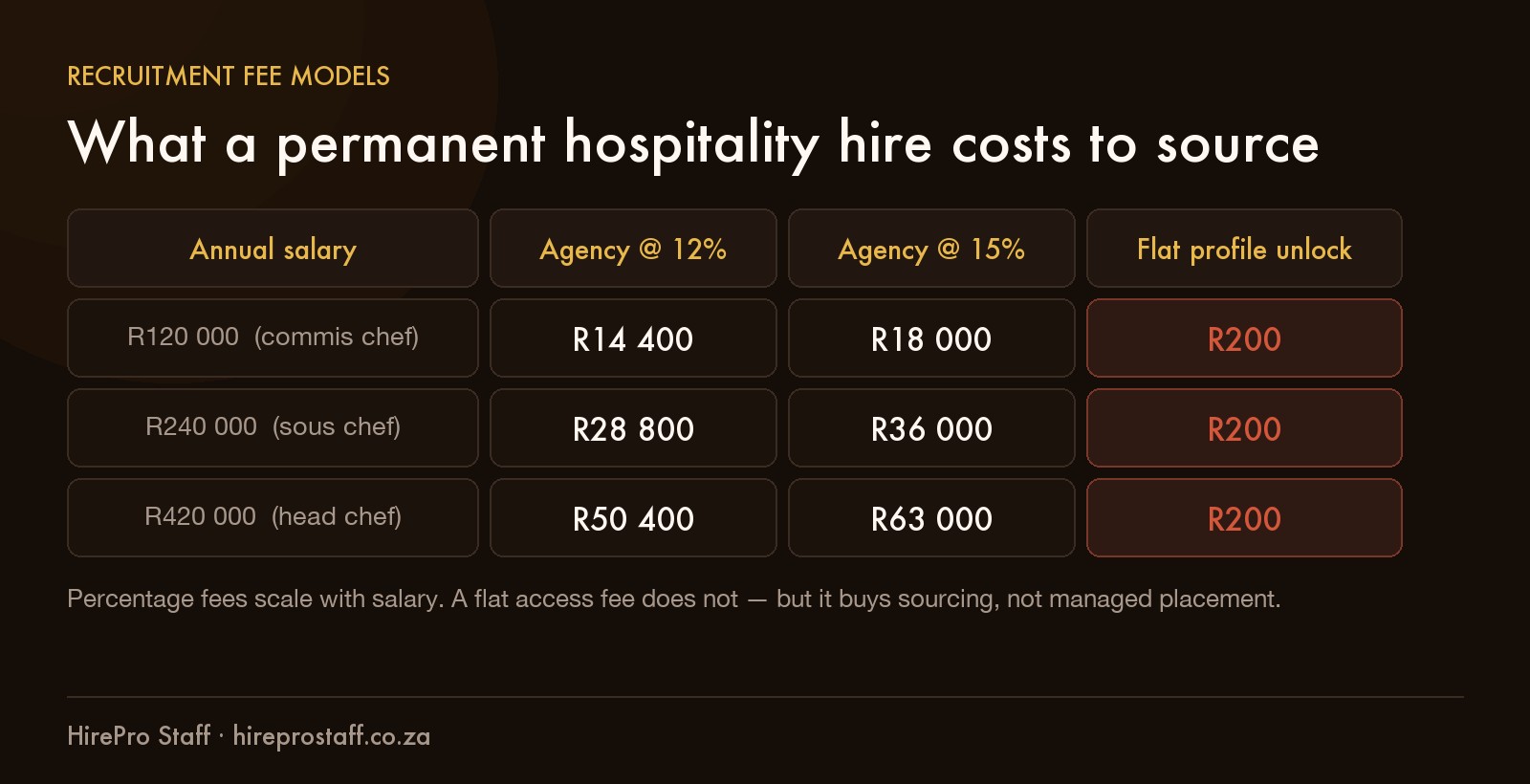
Percentage fees are quoted against annual package, so the same recruiter costs very different amounts depending on who you hire. Here is the arithmetic at rates commonly quoted in the South African market:
| Annual salary | Agency at 12% | Agency at 15% | Flat unlock |
|---|---|---|---|
| R120 000 (commis chef) | R14 400 | R18 000 | R200 |
| R240 000 (sous chef) | R28 800 | R36 000 | R200 |
| R420 000 (head chef) | R50 400 | R63 000 | R200 |
An important caveat before you use these figures: 12–15% is a commonly quoted range, not a regulated or universal rate. South African agency fees vary widely by role seniority, exclusivity and how hard the search is. Always ask for the actual percentage in writing, and confirm whether it applies to basic salary or total cost to company — that single definition can change the invoice by thousands.
Why the cheapest option is not automatically the right one
Here is the honest version, and it is not the one a staffing platform usually writes.
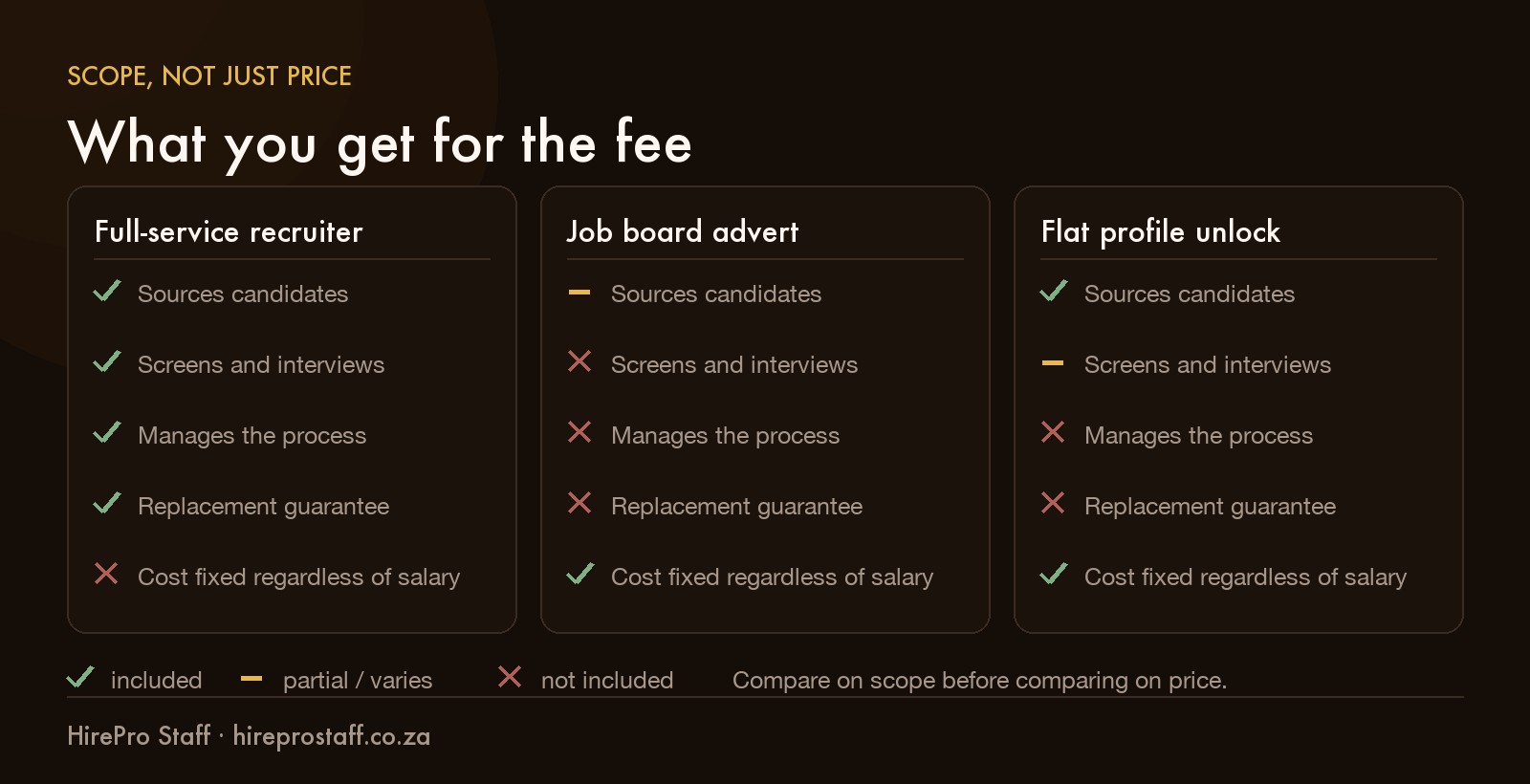
A percentage fee buys you work. A good recruiter writes the brief, filters a large pool down to a handful, checks references, manages the awkward salary conversation, and replaces the hire free of charge if it fails inside a guarantee period. If you are hiring a head chef who will define your food for the next three years, and you do not have time to screen forty applications, that fee can be excellent value.
A flat sourcing fee buys you access. You see the candidates. You still do the interviewing, the reference checks, the offer and the onboarding. If you know exactly what you want, have hired that role before, and have someone who can run a proper process, you are paying for the part you actually needed.
The question is not "which is cheaper?" It is "which part of hiring do I need someone else to do?"
What to confirm before you sign anything
Whatever model you choose, get these in writing. Each one is a real invoice dispute waiting to happen:
- 1The exact percentage or fee, and whether it applies to basic salary, total package or cost to company.
- 2When the fee becomes payable — on offer acceptance, on start date, or after a probation period.
- 3The replacement guarantee — how long it runs, whether it is a free replacement or a refund, and what voids it.
- 4Exclusivity — whether you are barred from hiring a candidate you were already speaking to.
- 5Ownership of introductions — how long a candidate "belongs" to the agency after an introduction, which can trigger a fee months later.
- 6What screening was actually done — "vetted" means very different things to different suppliers.
That last point deserves emphasis. Ask specifically: did you interview this person, did you verify their employment dates, and did you speak to a named referee? A CV that has been reformatted is not a CV that has been checked.
Where HirePro fits, and where it does not
HirePro's Talent Pool is a flat-fee sourcing model. You browse vetted hospitality candidates, shortlist and compare them, and unlock contact details for a flat R200 per candidate. There is no percentage of salary and no placement fee, and the cost is the same whether you hire a sculler or an executive chef.
What that includes: candidates are reviewed and approved by a person before they appear, and their profile carries verified work history, qualifications and references gathered during onboarding.
What it does not include: we do not run your interviews, negotiate your offer, or provide a replacement guarantee. You own the hiring decision and everything after the introduction. For some venues that is exactly right. For others — particularly a first senior hire, or a role you have never recruited before — a full-service recruiter genuinely earns their percentage.
We would rather tell you that plainly than sell you the wrong model.
A simple decision rule
- Hiring a junior or mid-level role you understand well, with someone in-house who can interview? Flat-fee sourcing is usually the better value.
- Hiring a senior or business-critical role, or hiring while short-staffed with no time to screen? The managed service is often worth the percentage.
- Very high volume, low seniority? A job board advert may beat both, provided you can handle the application load.
If you want to see what vetted candidate profiles look like before deciding, the HirePro demo opens a sample workspace with no sign-up. Or browse the Talent Pool if you are ready to compare real candidates.
Hiring well is expensive either way. The goal is to pay for the part you actually need.