"One waiter per ten guests" is the rule everyone quotes and almost nobody should use. It ignores the two things that actually drive floor workload: what kind of service you are running, and how far your staff have to walk.
Here is a way to build the number properly, starting from a 300-guest wedding and adjusting from there.
Start with service style, not guest count
The same 300 guests need very different teams depending on how the food reaches them.
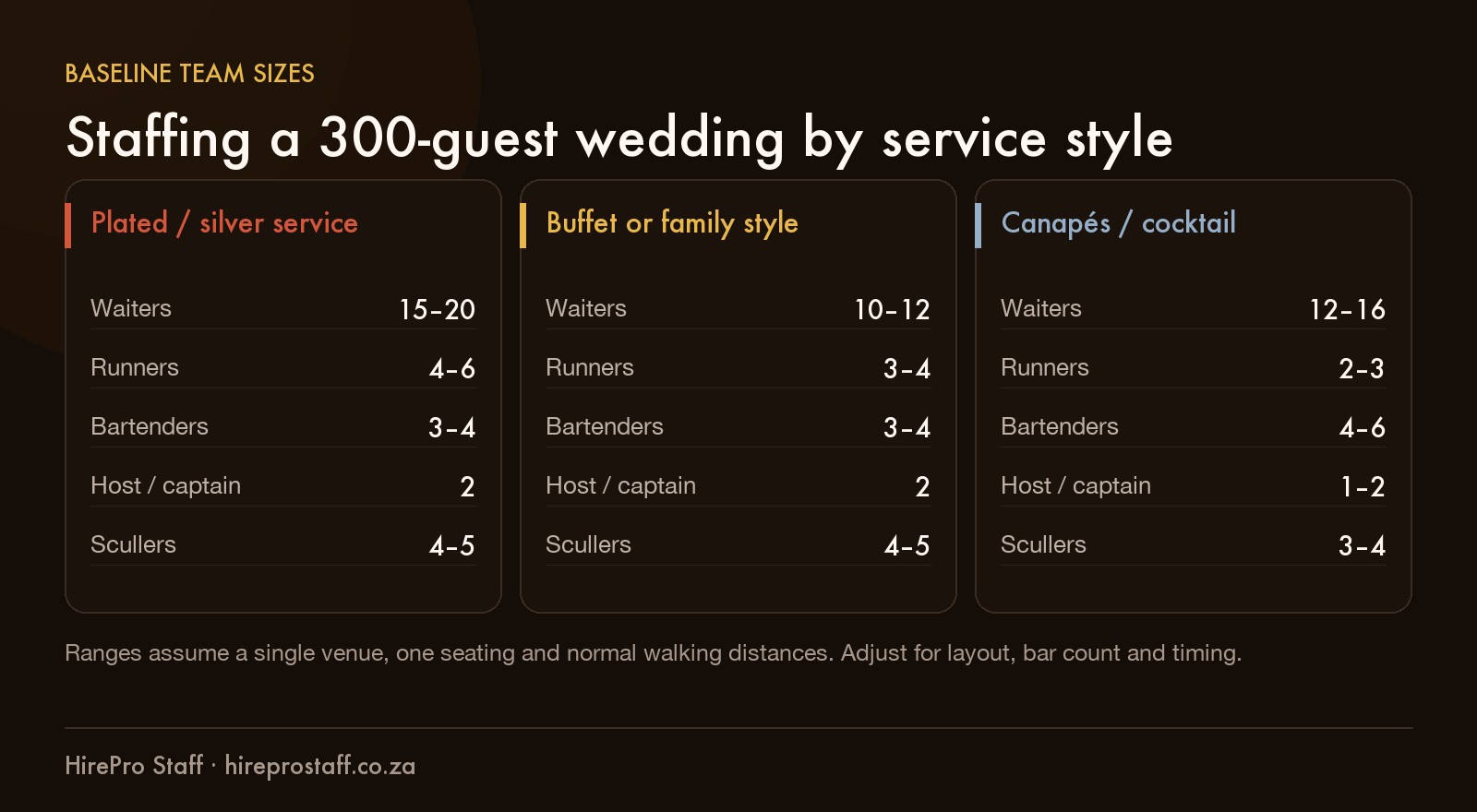
| Role | Plated | Buffet / family | Canapés |
|---|---|---|---|
| Waiters | 15–20 | 10–12 | 12–16 |
| Runners | 4–6 | 3–4 | 2–3 |
| Bartenders | 3–4 | 3–4 | 4–6 |
| Host / captain | 2 | 2 | 1–2 |
| Scullers | 4–5 | 4–5 | 3–4 |
Plated service is the most staff-hungry because every plate is carried to a specific seat, and 300 mains ideally land within a few minutes of each other. Buffet cuts your floor team but not your back-of-house: someone still clears, resets and runs crockery. Canapé service looks light and then surprises people — constant circulation with trays is more walking than a seated service, and the bar carries far more of the evening.
Treat these as a starting point, then adjust.
The five adjustments that actually change the number
Apply these to the baseline. Each one is a real reason to move up or down.
- 1Bar count and placement. One bar for 300 guests creates a queue that never clears. Two bars at opposite ends usually need one extra bartender total but transform the guest experience — and reduce floor staff being asked to fetch drinks.
- 2Walking distance. A marquee with the kitchen 80 metres away is a fundamentally different job to a restaurant with the pass behind the wall. If your runners are walking more than about 30 seconds each way, add one or two.
- 3Simultaneous service. If the couple wants all 300 mains down at once, you need the higher end of the range. If a staggered ten-minute spread is acceptable, you can work at the lower end.
- 4Course count. A four-course plated menu is roughly twice the floor work of two courses — more clearing, more resetting, more cutlery.
- 5Speeches and timing. Long speech blocks compress service into shorter windows, which needs *more* staff, not fewer, despite the same food volume.
The right question is not "how many staff per guest?" It is "how many plates or drinks have to move in the busiest fifteen minutes, and how far?"
Do not book the whole team for the whole day
This is the single most common overspend in event staffing.
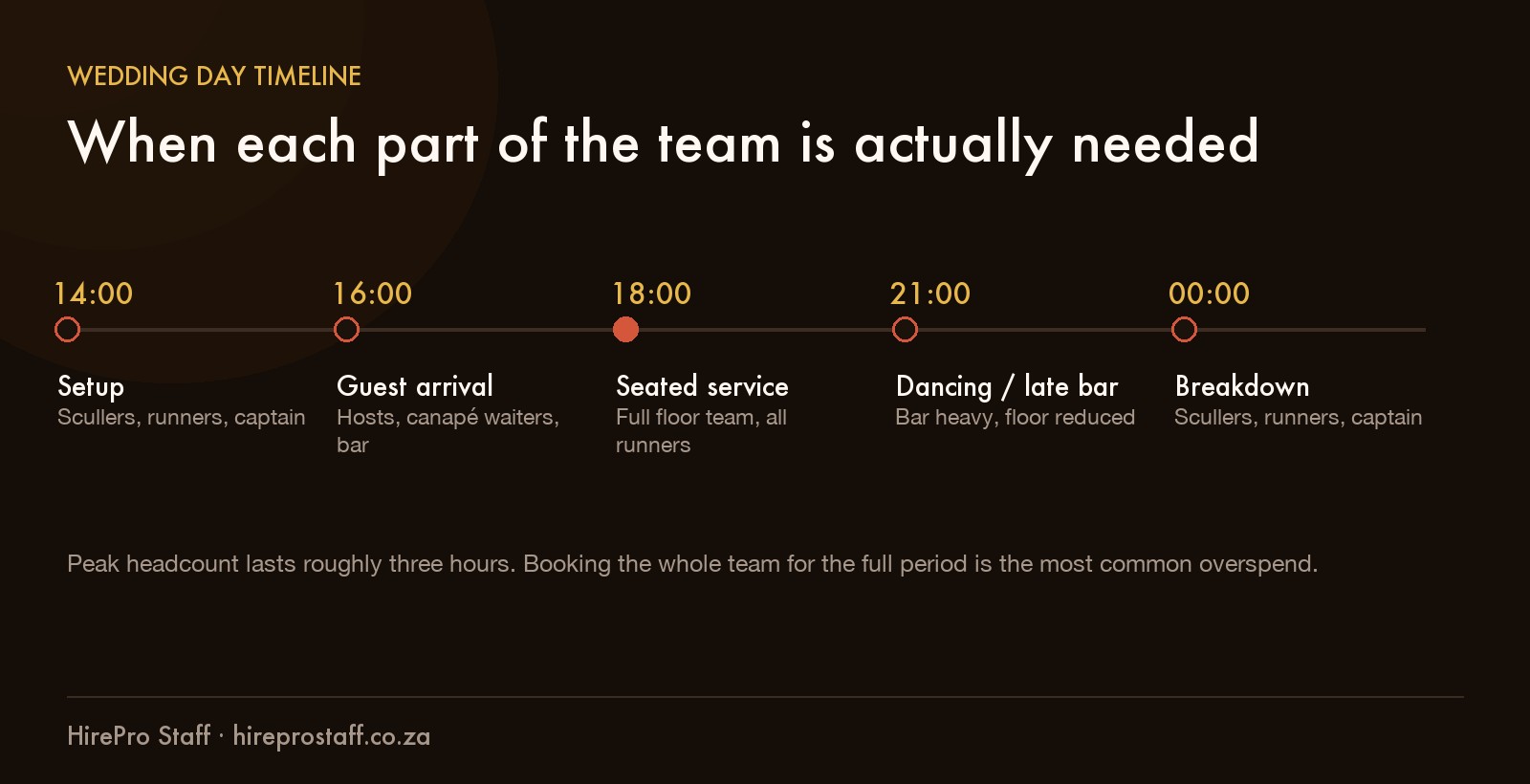
Setup needs scullers, a couple of runners and your captain — not twenty waiters. Breakdown is the same. Your full floor team is genuinely needed from about an hour before seated service until the last course is cleared, which on most weddings is a three to four hour window inside a ten-hour day.
Staggering call times by role is where the savings are. Bring the setup crew at 14:00, the bar at 15:30, the full floor team at 17:00, and release two-thirds of the floor after dessert while the bar and a skeleton crew carry the late session.
Build the roster by station, then sanity-check it
A practical method that takes about fifteen minutes:
- 1Draw the floor plan and divide it into sections of roughly 15–20 guests for plated service, or 25–30 for buffet.
- 2Assign one waiter per section, then add a captain per 8–10 waiters.
- 3Count the bars, allow 75–100 guests per bartender for a standard bar, fewer if you are serving cocktails.
- 4Add runners — roughly one per three to four waiters for plated, fewer for buffet.
- 5Add back-of-house: scullers scale with crockery volume, not guest count. Four courses on china needs more than two courses on shared platters.
- 6Add one float. Someone will not arrive, or will be needed somewhere unplanned. A team of twenty with no slack is a team of nineteen the moment anything goes wrong.
Then sanity-check against the busiest fifteen minutes. If main course service means 300 plates leaving the pass in twelve minutes, and each runner can carry three plates per trip with a 40-second round trip, the arithmetic tells you whether your plan is fiction.
What to confirm with the venue before you book anyone
- Where is the kitchen or prep area relative to the guests?
- How many service entrances, and is there a lift?
- What is the crockery situation — hired, and who washes it?
- Is there a staff area, and where do people leave their bags?
- What time can staff access the venue, and when must they be off site?
- Is there parking, and how do late-finishing staff get home safely?
That last one matters more than it sounds. A midnight finish at a Winelands farm with no transport plan is how you end up short-staffed at 22:00 next time — word travels fast among good event staff.
Booking the team
For Western Cape weddings, HirePro lets you build the exact team by role and shift time rather than accepting a fixed package. You can book waiters, runners, bartenders and general event support for the specific hours you need — with staggered call times per role, and the itemised price shown before you confirm.
For Winelands venues specifically, Stellenbosch and Franschhoek have their own coverage, and travel time is worth building into your call times.
If you want to model a team and see the cost before committing, the interactive demo lets you build a sample event roster with no sign-up.
A last piece of advice: book earlier than feels necessary. December and the February–April wedding season are the two periods when good event staff are committed weeks ahead, and a Saturday in March is not a day you want to be sourcing at short notice.