Front-of-house hiring gets treated as the easy part. It is not. A weak kitchen hire shows up in the food; a weak floor hire shows up in the guest's memory of the entire evening — and in the tip, the review and whether they come back.
Here is how to hire waiters, hosts and bar staff in a way that holds up.
Start by pricing what turnover is really costing you
Venues budget for the advert and the agency fee. Almost nobody budgets for the rest, which is where the money actually goes.
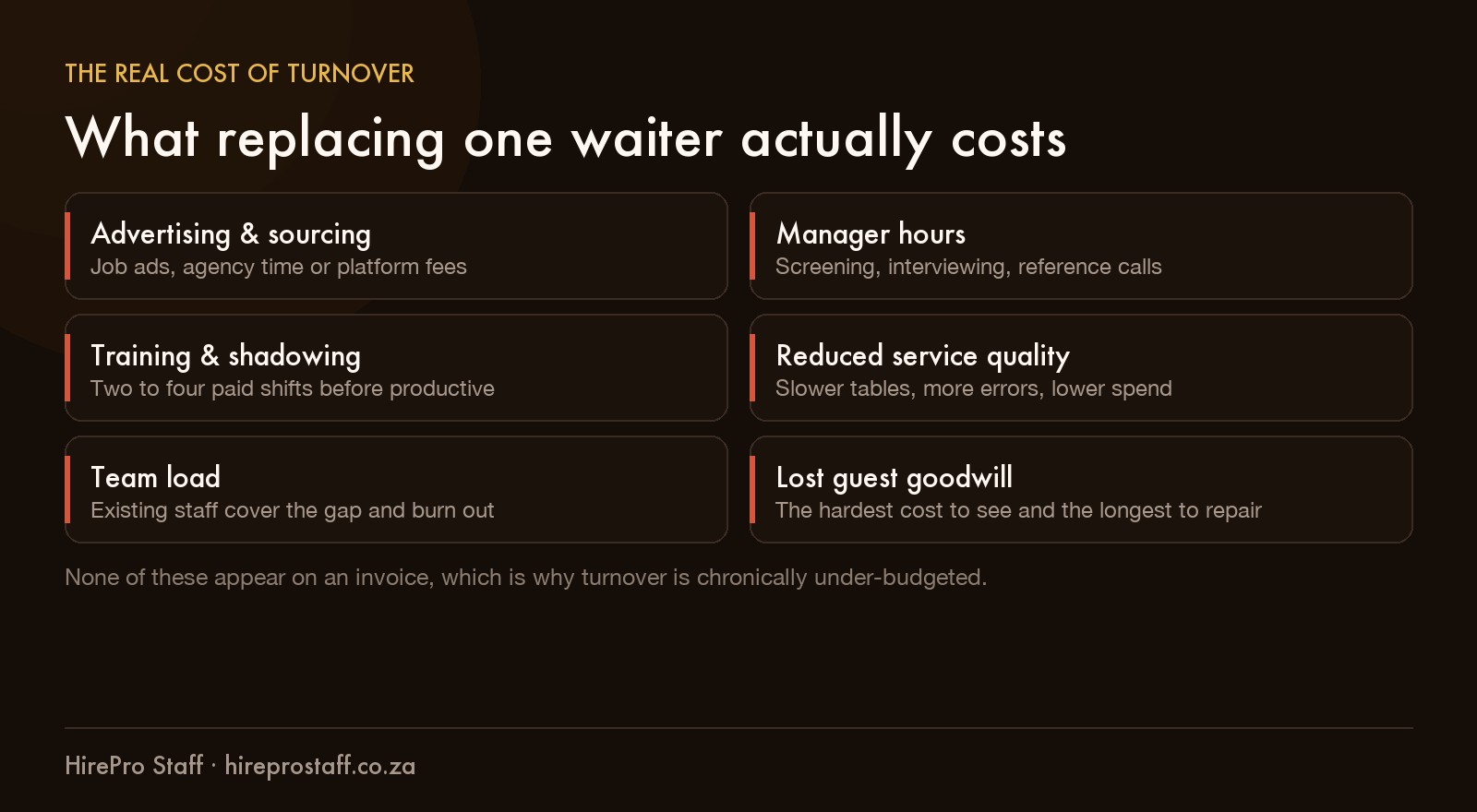
A new floor staff member typically needs several paid shifts before they are running a section unsupervised. During that time a senior server is training rather than selling, tables turn slower, and mistakes go to guests. If you replace the same position three times in a year, you are carrying that cost three times — which is usually far more than the difference between a hire that lasted and one that did not.
That reframes the whole exercise. The goal is not to fill the shift on Friday. It is to make the *next* hire the last one for a while.
Hire for service instinct, not just experience
Experience is easy to verify and a poor predictor on its own. Someone with three years at a high-volume chain may never have handled a complaint without a manager. Someone with one year at a small owner-run bistro may have done it forty times.
The traits that actually correlate with strong floor staff:
- Reading a table. Knowing when guests want conversation and when they want to be left alone.
- Pace awareness. Sensing that table six is about to need something before they raise a hand.
- Recovery under pressure. What happens after they drop a plate or a dish comes out wrong.
- Genuine menu curiosity. People who ask about the food sell more of it.
- Team behaviour. Whether they clear someone else's table without being asked.
Interview questions that reveal something
Skip "where do you see yourself in five years". Ask for specific incidents, then ask what happened next:
- 1"Tell me about a guest complaint you handled yourself. What did you say?"
- 2"You are running six tables and two need you at once. Walk me through it."
- 3"A guest says the dish is wrong but the kitchen made it to spec. What do you do?"
- 4"What is something on our menu you would want to try, and why?"
- 5"Tell me about a service that went badly. What was your part in it?"
That last question is the most useful in the set. Candidates who can describe their own contribution to a bad night — without blaming the kitchen, the manager or the guests — are almost always the ones who improve.
Ask for a specific story, not a general philosophy. Anyone can say they are guest-focused. Few can describe a Tuesday when it was hard.
Run a paid trial shift, then watch the right things
A trial shift tells you more in four hours than three interviews. Pay for it — someone serving your paying guests is working, and treating it as free labour is both a legal exposure and a fast way to earn a reputation in a small industry.
During the shift, watch what a CV can never show:
- Do they greet a table within a minute, or wait to be summoned?
- Do they carry something back to the kitchen every time they walk that way?
- How do they behave in the last hour, when they are tired?
- Do the existing staff naturally start including them?
That last signal is worth as much as anything you will observe. Your current team knows within one service whether someone is going to work out.
Permanent hire or flexible cover?
A large share of front-of-house hiring pain comes from using the wrong model — hiring permanently for demand that is genuinely seasonal, or repeatedly booking casual cover for hours that are entirely predictable.
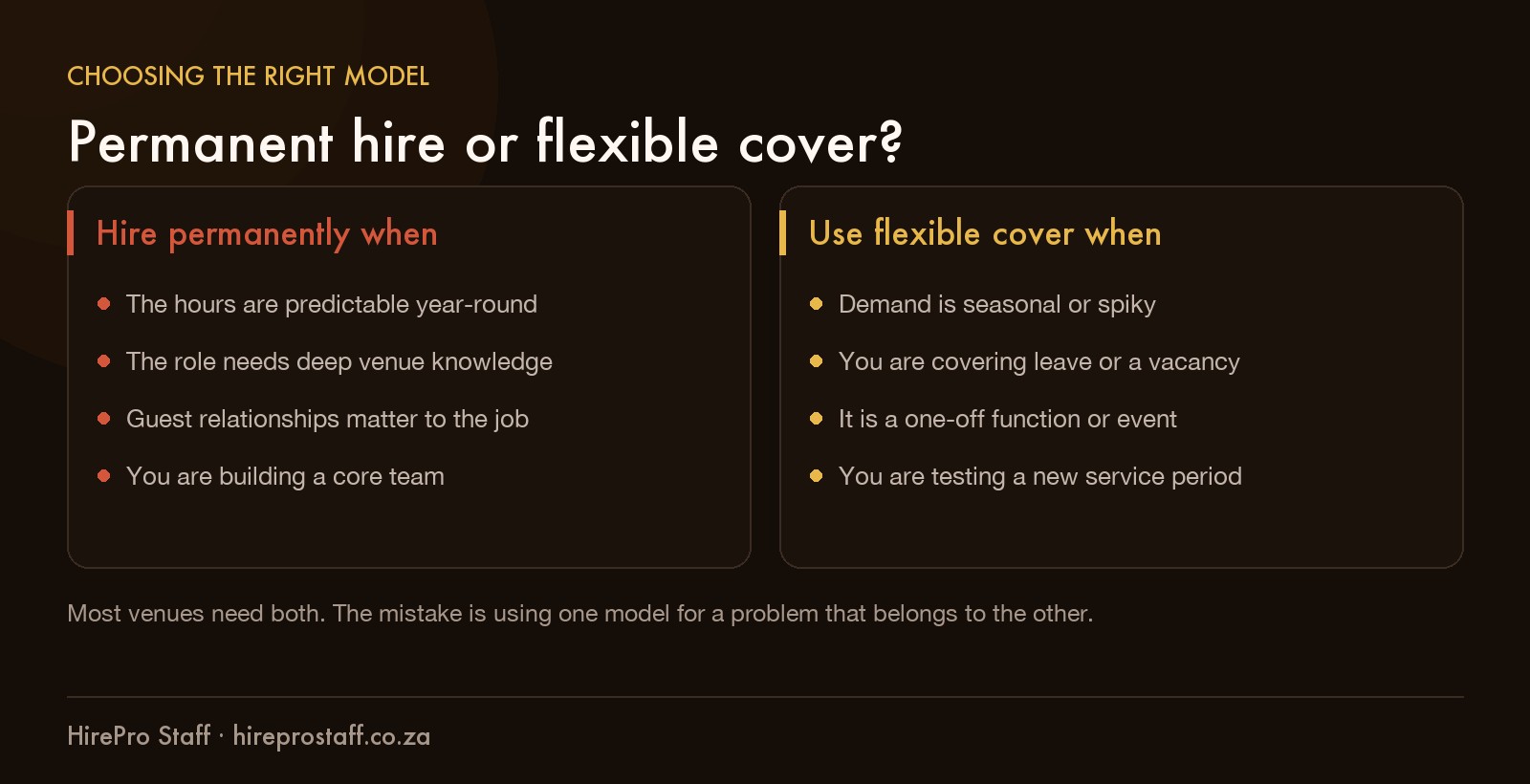
A practical test: look at the last twelve months of covers. If a service period was busy in eleven of them, that is a permanent role. If it spiked in three, that is flexible cover. If you genuinely cannot tell yet — a new brunch service, an unproven second sitting — use flexible staff to find out before you commit to a salary.
Make it easy to say yes
Hospitality candidates are usually talking to more than one venue. Small operational things decide who accepts:
- Reply within a day. Silence loses good people to whoever answered first.
- Be specific about the shift pattern before the offer, not after.
- State the hourly rate or salary in the advert. Vagueness filters out the confident candidates, not the weak ones.
- Confirm the start date and who they report to in writing.
Two ways HirePro can help
For permanent front-of-house roles, the Talent Pool carries vetted hospitality candidates across South Africa — Cape Town, Johannesburg, Durban, Pretoria, Gqeberha and more. Browse profiles, compare experience, and unlock contact details for a flat R200 per candidate. No percentage of salary, no placement fee. You run the interviews, the trial and the offer.
For shift cover in the Western Cape, on-demand booking lets you fill a specific service without adding to payroll — useful while a permanent role is vacant, or for a function that does not justify a hire. You can hire waiters, hosts or bartenders by date and shift time, with the itemised price shown before you confirm.
Worth being clear about the boundary: on-demand hourly shifts operate only in listed Western Cape districts. The Talent Pool for permanent hiring is nationwide. If you are outside the Western Cape, permanent hiring is what we can help with.
See how both work in the interactive demo — sample data, no sign-up, nothing charged.