Cape Town's December is not a busy month. It is roughly six weeks that can carry a disproportionate share of the year's revenue, arriving at exactly the moment your existing team wants leave and your competitors are hiring from the same pool.
The venues that handle it well are not the ones who work hardest in December. They are the ones who made three decisions in September.
Start now, not in November
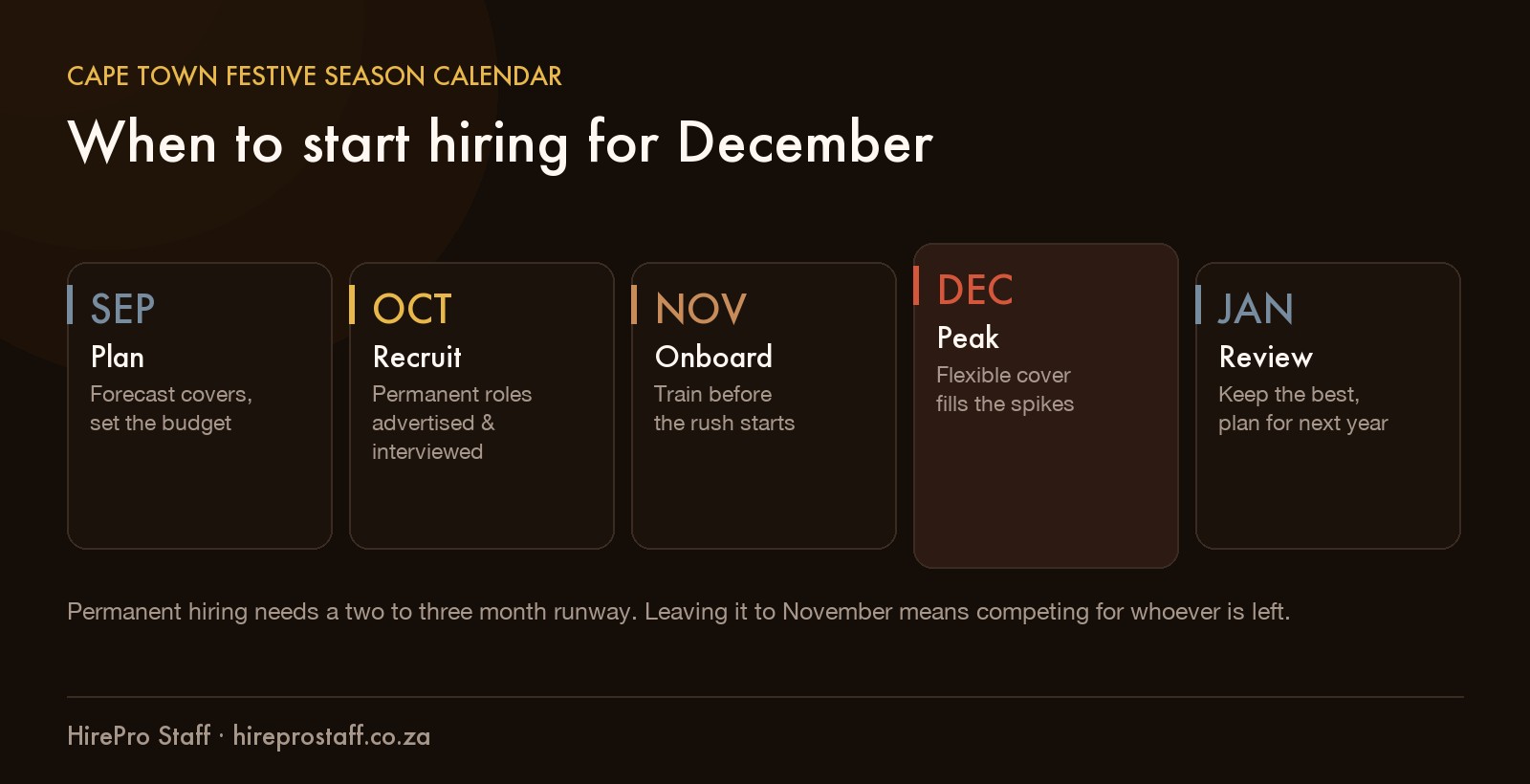
The timing problem is simple arithmetic. A permanent hire needs advertising time, interview time, a notice period — often a full calendar month in hospitality — and then training before they are useful. Start in November and your new hire is learning your menu during your busiest week, which is the worst possible time to be learning anything.
Start the permanent recruitment in September or early October. Use flexible cover for the spikes you cannot forecast. Those are two different tools and the mistake is using one for the other's job.
The twelve-month test
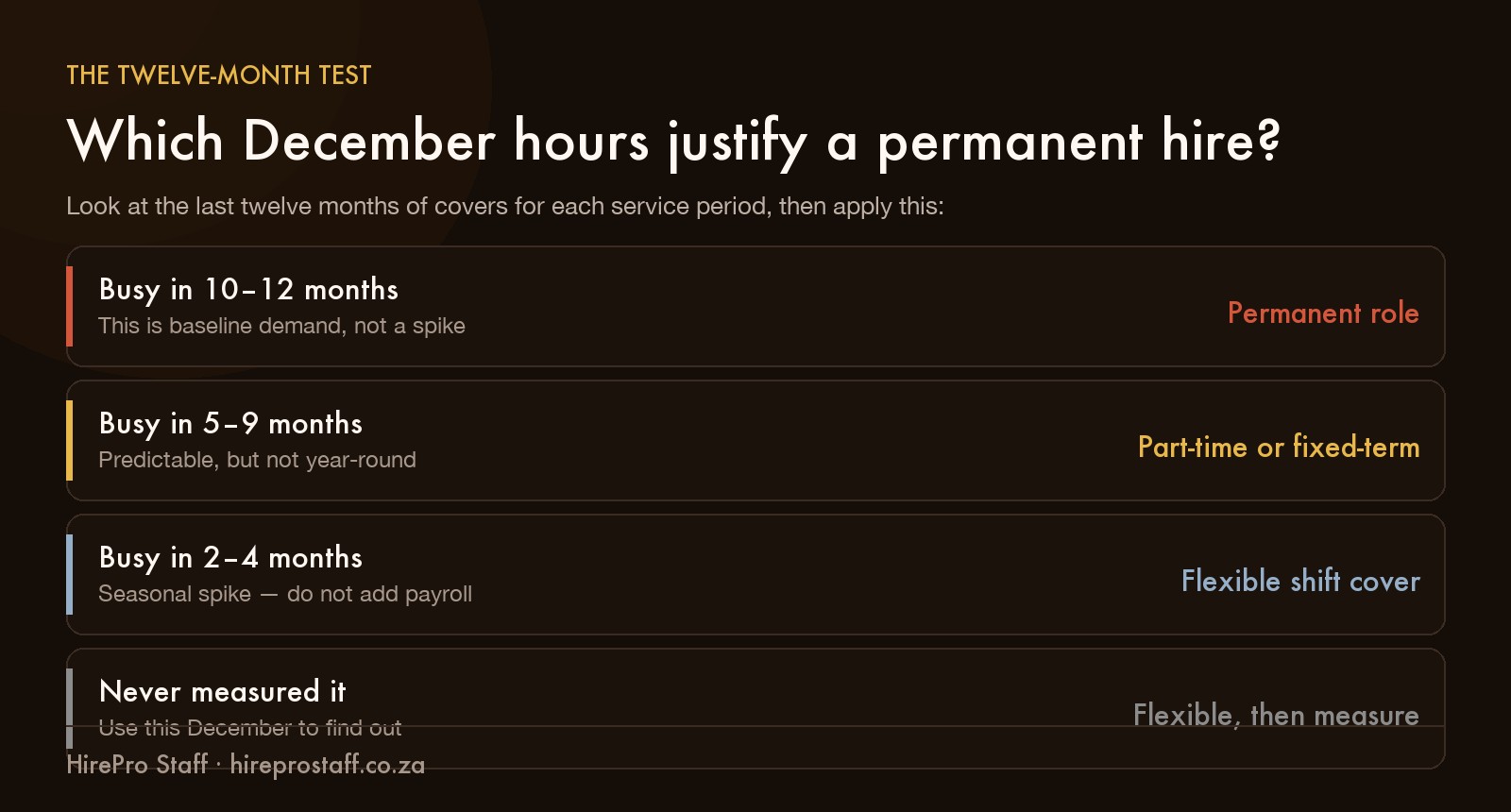
Here is a decision rule that works better than instinct. Pull your covers for the last twelve months, split by service period — Friday dinner, Saturday lunch, Sunday brunch, and so on. Then for each one, ask how many months it was genuinely busy.
| Busy in… | The right model | Why |
|---|---|---|
| 10–12 months | Permanent role | This is baseline demand, not a spike |
| 5–9 months | Part-time or fixed-term | Predictable, but not year-round |
| 2–4 months | Flexible shift cover | Seasonal — do not add to payroll |
| Never measured | Flexible, then measure | Use this December to find out |
The trap is hiring permanently off a December high. A venue that adds three permanent waiters in November is carrying those salaries through May, when Tuesday dinner is twelve covers. Conversely, a venue that has run flat out every Friday for two years and still books casual cover every week is paying a premium for something it should have hired for.
If you cannot say how many months a service period is busy, that is the first thing to fix — and it costs nothing but an hour with your booking data.
What December actually needs, by role
Front-of-house demand does not scale evenly:
- Waiters and runners scale roughly with covers, but runners scale faster if your terrace or overflow seating opens. Extra outdoor tables mean longer walks.
- Bar staff scale faster than covers. December drinking is not December eating — the ratio shifts, and a queue at the bar is more visible to guests than a slow starter.
- Hosts become disproportionately important. Managing a waitlist on a fully-booked night is the difference between a warm memory and a bad review.
- Scullers are the most under-booked role of the season. Every extra cover generates crockery, and a backed-up wash-up stops the entire kitchen. This is the cheapest role to add and the most expensive to be short of.
If you add one person on the strength of this article, make it a sculler on your busiest nights.
Plan the leave problem before it plans you
Your existing team also wants time off in December, and they have a legal entitlement to leave. Handled badly, this is how venues lose good permanent staff in January.
Practical approach:
- 1Ask for leave requests by end of September. Late requests are far harder to accommodate fairly.
- 2Publish the December roster by mid-November. People make family plans; a roster dropped on 1 December generates resignations.
- 3Be explicit about the trade. Many staff will work Christmas for a guaranteed run of days in January. Say so openly and honour it.
- 4Do not roster your most experienced people every single peak night. Burnout in week two costs you weeks three through six.
- 5Confirm public holiday and Sunday pay rules with your payroll before December, not in the January dispute.
Keep the seasonal team from falling apart on the 27th
The last week of December has a distinct failure mode: your seasonal staff have had their big earning nights, are tired, and the shifts between Christmas and New Year are the easiest to no-show.
What reduces it:
- Book the same people repeatedly. Someone on their fifth shift at your venue behaves differently to someone on their first.
- Confirm shifts closer to the date, not only at booking. A confirmation the day before is worth more than one three weeks out.
- Have named backup per critical role, not a general hope. Two deep on bar and wash-up.
- Pay promptly. Nothing damages seasonal reliability faster than a late payment in the first week.
- Brief properly, every time. Five minutes on menu, layout and escalation prevents most service errors.
Where the two products fit
For permanent December hires — the roles the twelve-month test says are baseline demand — the Talent Pool carries vetted hospitality candidates nationwide. You browse profiles, compare experience and unlock contact details for a flat R200 per candidate, then run your own interviews and offer. Start this in September; by late November the good candidates are committed.
For the spikes — the December-only volume that does not justify a salary — on-demand booking covers specific shifts in Western Cape districts without adding to payroll. You can book waiters, bartenders, scullers and runners for exact dates and hours, with the itemised price shown before you confirm.
A practical note on timing: December is the single most competitive month for flexible hospitality staff in Cape Town. The venues that get their first-choice people are the ones who book in October and November, not the ones calling around on 15 December.
If you want to model a December roster and see the cost before committing to anything, the interactive demo lets you build sample shifts with no sign-up. And if you are outside the Western Cape, permanent hiring through the Talent Pool is available nationwide — the hourly shift booking is Western Cape only.