This is the question that keeps restaurant owners awake, and almost nobody publishes a straight answer to it: *if I book casual staff for Saturday and something goes wrong, who is actually responsible?*
What follows is orientation, not legal advice. It is written to help you ask better questions and spot the gaps — not to replace a labour practitioner who knows your specific arrangement. Where something turns on your facts, we say so plainly rather than guessing.
Start with the only question that matters
Every downstream obligation flows from one thing: who is the employer of the person standing on your floor?
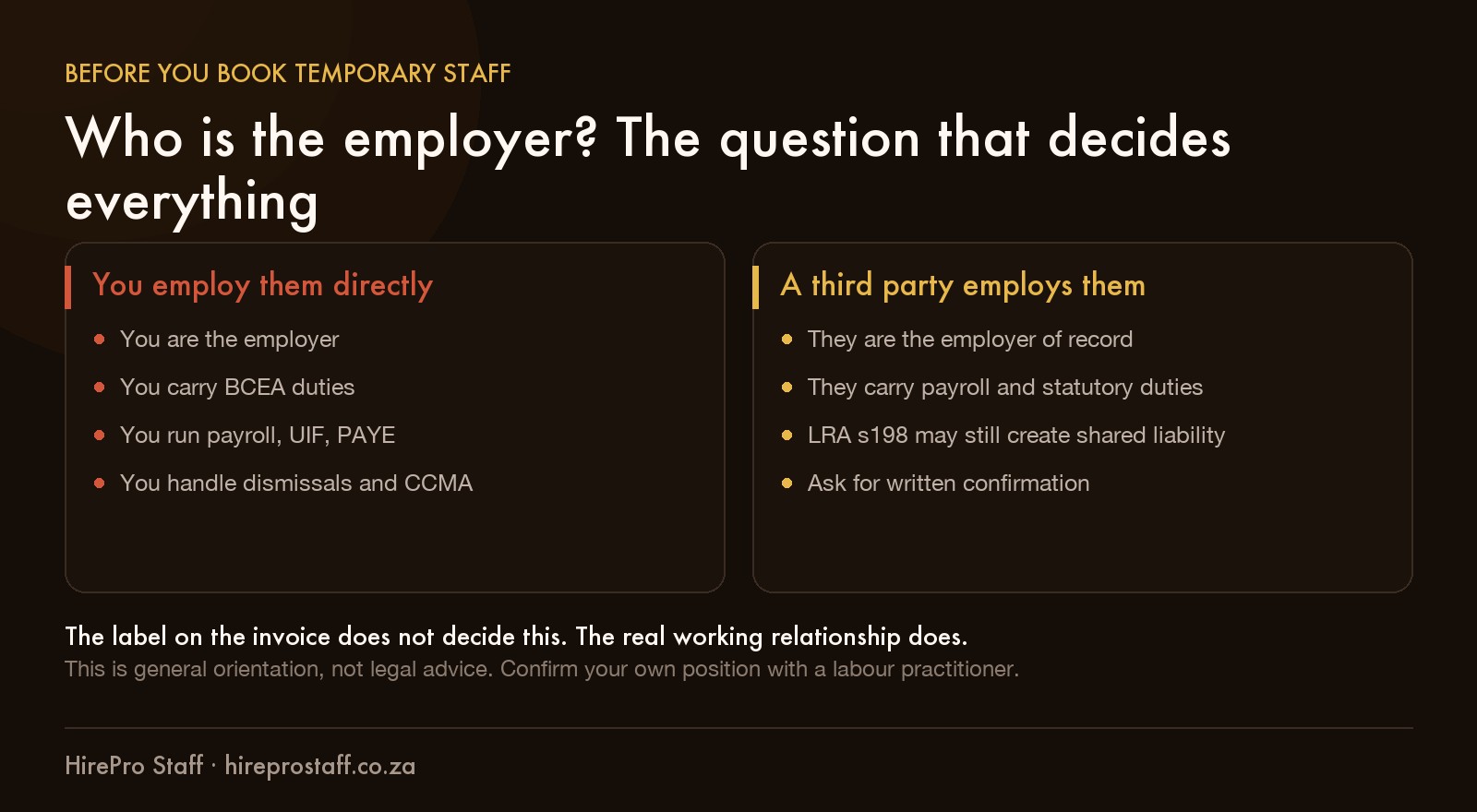
If you employ them — even for one shift, even paid cash, even called "casual" — you carry the employer duties. Calling someone an independent contractor does not make them one. South African law looks at the substance of the relationship: who controls the work, who sets the hours, whose equipment is used, and whether the person is genuinely running their own business.
If a third party is the employer of record, they carry payroll and statutory registration. But this is where venues get caught out: under section 198 of the Labour Relations Act, arrangements involving temporary employment services can create joint and several liability for certain contraventions. In plain terms, "the agency handles it" is not automatically a complete defence. Get the arrangement confirmed in writing, and get it reviewed once.
The word "casual" has no magic legal effect. It describes how you think about the shift, not what the law thinks about the relationship.
What the BCEA covers, in practice
The Basic Conditions of Employment Act sets minimum standards. Where you are the employer, these are the ones that bite in hospitality:
- Ordinary hours and overtime. Overtime is not optional to pay, and it cannot be waived by a verbal agreement.
- Meal intervals and rest periods. A continuous shift past a threshold triggers a break entitlement.
- Sunday and public holiday work, which carry premium pay rules — directly relevant to a December-heavy trade.
- Night work provisions where shifts run late.
- Payslips and record-keeping. You must keep records of hours worked and payments made. This is the single most common gap we hear about, and it is also the easiest one to fix.
- The National Minimum Wage, which is updated periodically. Check the current figure rather than relying on last year's number.
Two further registrations sit outside the BCEA but matter just as much: UIF contributions, and COIDA cover for workplace injury. A kitchen is a genuinely hazardous environment. If someone is burned or cut on your premises, "who was covering them?" is a question you want answered before it happens, not after.
Eight questions to ask any staffing supplier
Ask these before someone works a shift for you. A supplier who cannot answer them clearly is telling you something.
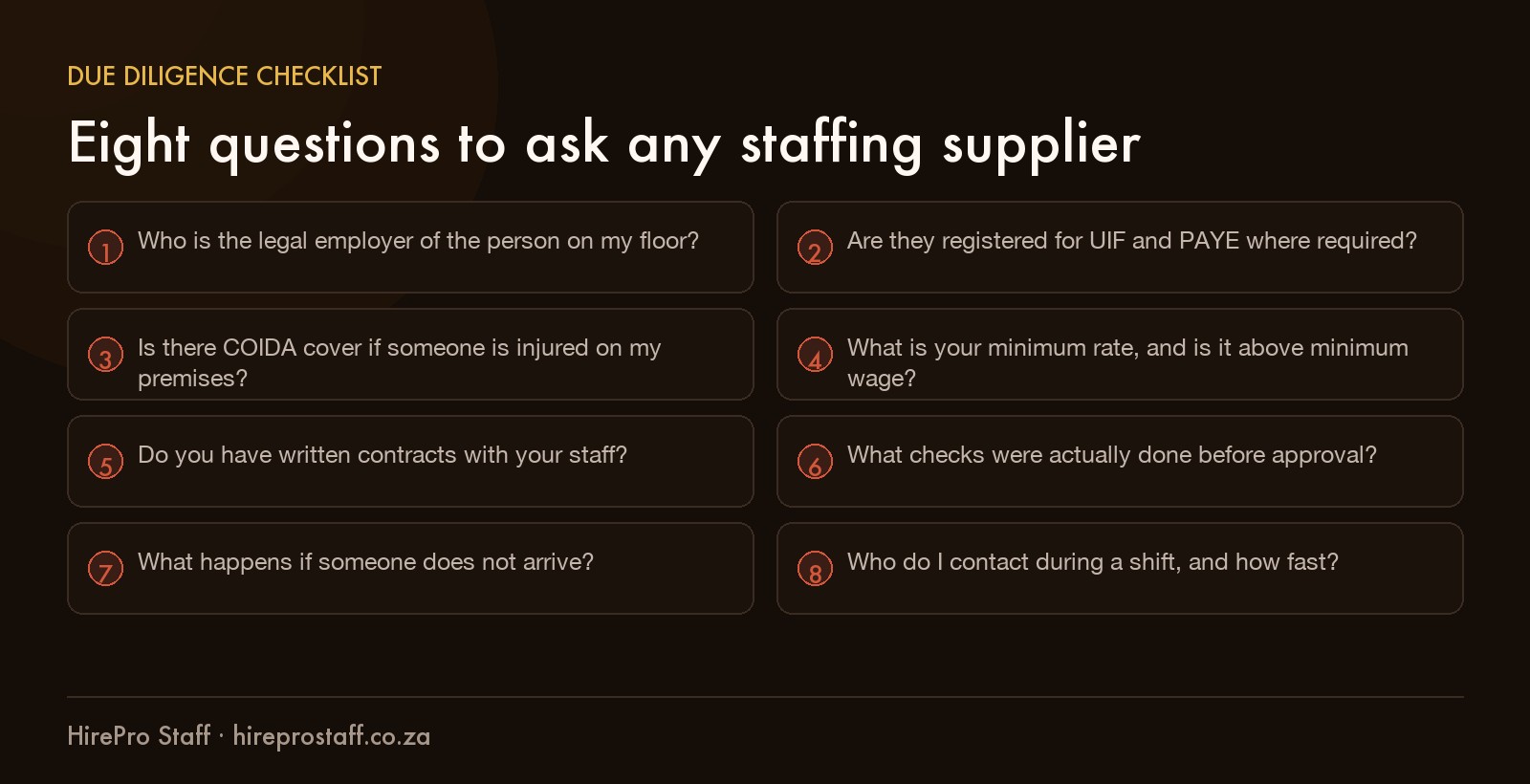
- 1Who is the legal employer of the person on my floor?
- 2Are they registered for UIF and PAYE where required?
- 3Is there COIDA cover if someone is injured on my premises?
- 4What is your minimum rate, and is it above the National Minimum Wage?
- 5Do you have written contracts with your staff?
- 6What checks were actually done before this person was approved?
- 7What happens if someone does not arrive?
- 8Who do I contact during a shift, and how quickly do they respond?
Question five deserves a note. Ask to see the template, not just a yes. Question six deserves the same: "vetted" means anything from a phone call to a full reference and document check, and the gap between those is where your risk lives.
About the phrase "labour broker"
You will see this term used loosely. It is worth being careful with it.
In South Africa, "labour broker" is colloquial shorthand that overlaps with the statutory concept of a temporary employment service under the LRA. The term carries real regulatory weight and a contested history, and misdescribing your own arrangement — in either direction — is not a neutral act.
If a supplier describes themselves this way, ask what it means for who employs the staff. If you are unsure how your own arrangement is classified, that is precisely the question to put to a labour practitioner. It is a short conversation and it is cheaper than the alternative.
Practical record-keeping that takes ten minutes a week
Whatever your arrangement, keep these for every temporary worker on your premises:
- The date, start time and end time actually worked, not just what was booked.
- Who they worked for — the supplier name, or your own payroll reference.
- The rate, and what was paid.
- Any incident — injury, damage, complaint — recorded on the day.
- A copy of the booking confirmation or invoice.
If a dispute reaches the CCMA, the party with contemporaneous records is in a substantially better position than the party reconstructing events from memory months later. This is not a legal trick; it is just how evidence works.
What we can and cannot tell you about HirePro
Being straight about this matters more than a marketing line.
HirePro is a platform. Venues book vetted staff through it, the booking terms are set out in writing, hours are recorded in the system, and the itemised rate is shown before you confirm. Every shift generates a record you can point to — which is genuinely useful for the record-keeping above.
What we will not do is tell you, in a blog post, how your specific arrangement is classified in law or which statutory duties fall on you rather than anyone else. That depends on facts we do not have, and anyone who answers it confidently in an article — including a staffing platform — is overreaching. Our terms set out the platform arrangement, and a labour practitioner should review it against your own operation once.
That review is a one-off cost. Most venues never do it, and most of the time nothing happens. But "most of the time" is doing a lot of work in that sentence.
A reasonable starting checklist
- Read your supplier's terms once, properly.
- Get the employer-of-record question answered in writing.
- Confirm COIDA and UIF position before, not after, an incident.
- Keep hours and incident records for every shift.
- Have a labour practitioner review your arrangement once.
- Re-check the National Minimum Wage figure annually.
If you want to see how shift terms, hours and itemised rates are recorded before you commit to anything, the interactive demo shows the booking flow with sample data and no sign-up. You can also read how booking works for venues.